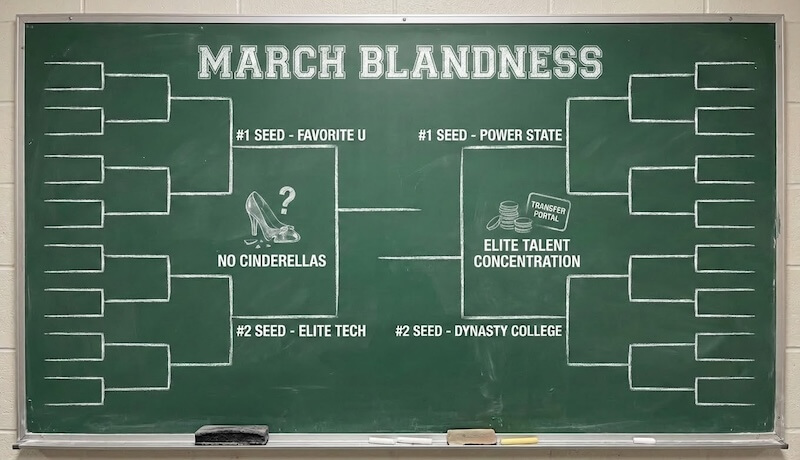
For those who tune into the NCAA Basketball Tournament each year for wild upsets and Cinderella stories, the 2025 tournament was historically favorite-heavy – ”chalky” in sports-insider parlance. Only one double-digit seed advanced to the Sweet 16, and for the first time since 2017, no 13-, 14-, 15-, or 16-seed team won a first-round game. All four 1-seeds advanced to the Final Four, just the second time this has happened in the tournament’s history.
Looking back several years, the trend is even more grim. For the first time in history, there have been three straight tournaments without multiple double-digit seeds reaching the Sweet 16 (and potentially four straight after this year’s opening rounds).
Initial returns on this year’s tournament look to be much of the same—and Vegas seems to agree. For the first time since the tournament expanded in 1985, sportsbooks favored all 16 top-4 seeds in the first round by double digits, indicating a widening chasm between the teams at the top and the mid-major Cinderellas we could once count on to become the darlings of March.
The predictably quiet performance of underdogs in this year’s tourney has given us a couple more disheartening firsts:
- The first time in modern history we’ve had back-to-back years without a 13-, 14-, 15-, or 16-seed making the second round
- The first back-to-back years where no team from a mid-major conference has made the Sweet 16.
Is NIL to blame? The transfer portal and ability to pay college athletes has opened up the floodgates for mid-majors to lose their best players to power conference schools who come knocking with interest (and cash).
It doesn’t appear reinforcements are on the way—in fact, it may get worse. The NCAA appears hellbent on expanding the field to 72 or 76 teams in the near future. The beneficiaries: the Big 10 and SEC, who will now see an avenue for their middling conference teams to get an at-large bid in the tournament. Mid-majors, however, will still largely be dependent on winning their conference tourney to get in. The Cinderellas of the future won’t be the George Masons, the VCUs or the Davidsons—they’ll be the 12-seed Auburns, who finished sub-.500 in conference play.